When you drive along the savannah and also veld of South Africa, you can see a groups of lion’s cubs running amongst the high savannah lawn. Their ears keep an eye out of the yard as brilliant happy spots. The suggestions of their tails visit the wind with the turf where the cubs conceal. Leonotis leonurus, likewise known as Lion’s Ears, Lion’s Tail and also Wild Dagga, is a plant varieties in the mint family, Lamiaceae. The native environment of Leonotis leonurus is damp grasslands of Southern Africa, where it is really typical. Leonotis leonurus was one of the many Cape Plants taken to Europe for gardening objectives years earlier.
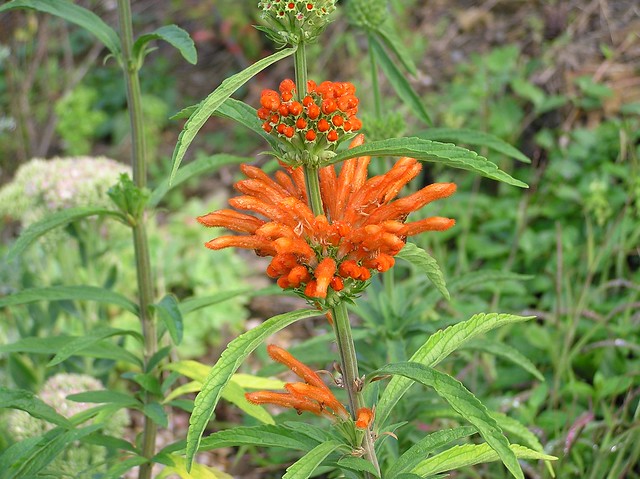
It is a fast-growing, soft-woody, durable hedge which grows up to 3-5 ft tall as well as 1-3 feet broad. The dark eco-friendly 2-4″ long directly lanceolate leaves are harsh on the top leaf surface, velvety on the lower fallen leave surface, and have toothed margins. These leaves are extremely fragrant when squashed and also have a strong herby fragrance! The stems are silky, woody at the base and also distinctively square in sample. The stems are fragile and can break in strong winds. The bush has tubular orange flowers in tiered whorls, typical to the mint family members. They rise above the foliage mass during the flowering season. It is they that take notice of themselves, presenting confusion and posing as lion ears and also tails!
Flower petals supposedly resemble Lion’s ears and also dark eco-friendly bunch of upper fallen leaves from a distance look like Lions tails. Much like an animal feline, a lion has a lengthy tail which aids it to stabilize. Unlike any other cat, a lion’s tail has a black tassel at the end, which initially shows up when it is in between 5 and also 7 months old. This can be utilized Lion’s mamas to lead other cubs through tall turf! Leonotis leonurus is primarily bird pollinated and also the flower discussion and pollination mechanisms are all structured to support this sort of pollinator. The leonotis leonurus blossoms include pleasant nectar that bring in lots of nectivorous birds such as sunbirds. The curved beaks of these African birds which are made use of for feeding from these tubular flowers have been a contributing variable to the brilliant orange-red shade and also tubular form of these blossoms due to co-evolution. The nectar and also pollen is also appealing to honey bees, butterflies and various other pests who additionally go to the blossoms. An interested thing, the plant proceeds expanding through the flower! This develops a multi-level look.
Typically the flowering duration remains in summertime, continuing in cozy regions through to fall and also winter in the tropics regions. In cooler parts of the world, this plant is grown in sunrooms for its ornamental value. Pruning might be beneficial to motivate repeat flowering. Apricot, white as well as yellow flowered kinds are additionally recognized. The white flowered from was referred to as Leonotis leonurus var. albiflora Benth, and is still widely grown today as an attractive choice to the orange flowered form. Hybrids in between the two can occasionally be seen as apricot tinted or off-white people. Leonotis leonurus has a lengthy history of medical usage by conventional African people. The infusions made from flowers and seeds, stems or leaves are extensively used to treat tuberculosis, jaundice, muscle pains, high blood pressure, diabetes, viral hepatitis, dysentery, as well as diarrhoea. The fallen leaves, roots as well as bark are utilized as an emetic for snakebites, as well as scorpion stings. The fresh stem juice is utilized as an infusion drunk for ‘blood impurity’ in some locations.
The dried flowers and leaves are known to develop a light soothing impact. The major active constituent is leonine and also in high dosages the plant is recognized to be harmful, impacting bodily organs, blood cells and also physical functions. Modern herbal medicine primarily utilizes this plant for premenstrual discomfort as well as a soothing tea infusion may be prepared. Leonotis leonurus is cultivated as an ornamental plant for its massive orange bloom spikes and is made use of as an accent or screen in yards and also parks. This plant needs at the very least 6 hrs of sunlight per day for optimal growth. It is dry spell forgiving when established, yet gain from routine watering when completely dry. There is no particular dirt kind required, except that the ground is well drained pipes. This plant is fairly frost forgiving, yet might shed its leaves in very frost susceptible locations as well as re-grow them when the weather condition comes to be warmer. Plant in full sunlight and also provide sufficient water throughout the growing season, application of a liquid fertilizer can be applied at the beginning of the brand-new season.
 Leonotis leonurus